If there is one thing the 2026 Winter Olympics proved, it’s that there is a whole new appetite for curling.
Let’s face it. Every four years when the Games come on, curling gets a bump in viewership and attention because so many people want to tune in to the Olympics in general. But afterwards, for whatever reason, the sport is forgotten until the next time the rings are in the background.
Something tells us that won’t be the case this time.
Forget the fact that the competition has never been deeper or better all around the world, the sport itself is headed to a new level that we’ve never seen before and like it or not, it’s because of one moment fans won’t soon forget thanks to Marc Kennedy from Team Canada and Oskar Eriksson on Team Sweden.
The double-touch controversy.
It was the never-ending story that kept leading the Olympics as different perpetrators found themselves in the headlines each new day.
However, none bigger than the viral moment between Kennedy and Eriksson where the two exchanged explicits on the ice during the middle of the game.
This launched one half of the internet into a frenzy as jokes surrounding the controversy reached all corners of the Olympic Games. While the other half tried to play judge and jury as they familiarized themselves with the World Curling rulebook and threw out cheating verdicts.
Heck, the ‘scandal’ became so big it infiltrated the daily IOC press briefings, booting out the regular political chatter and larger Games issues.
It led World Curling to change the rules mid-tournament just to change them back after Canada’s Rachel Homan and Great Britain’s Bobby Lammie had stones removed. The whole situation looked even worse because of that, but also, the continued discourse created more buzz each day.
Looking ahead, the sport seems more ready than ever to retain these new Olympic fans thanks to the first-ever professional curling league that is set to debut soon.
Six franchises, made up of 10 players each, will take the ice at the Mattamy Athletic Centre in Toronto, April 6-12, competing for a $250,000 prize purse.
For The Curling Group’s co-founder and CEO Nic Sulsky, this was the best unplanned timing.
“Since we founded TCG and acquired GSOC, our plan was always focused on harnessing the power and popularity of curling at the Olympics to launch Rock League and a Series A financing,” Sulsky told Sportsnet.ca.
“Curling has historically been the most watched winter Olympic sport so we knew the boost in popularity was inevitable. The fact that curling, due to the electric action on the ice, the engaging athletes and the non-cheating, cheating scandal, also made curling the most talked about sport, was an unexpected bonus.”
Now that curling has this juice behind it, the challenge, but fun part, for Sulsky and his team is using their time wisely until the season begins.
“Eighty per cent of the Olympic medallists are in Rock League. Fans all over the world have noticed how fun and entertaining curling is. Now, TCG, the curlers, and our broadcast partners will spend the next six-plus weeks (until the league’s debut) making sure the excitement for Rock League builds steadily,” said Sulsky.
Of course, there are also the regular popular events still left to come this season, with the Brier starting Friday, as well as the mixed doubles, women’s and men’s world championships left to be played.
While we wait for those, here are some of the biggest takeaways from the Winter Games.
Olympics still prove to be hardest thing to win in curling
Coming into these Games there was a clear favourite for the men’s and women’s events — Canada’s Team Homan for the women and Great Britain’s Team Bruce Mouat for the men.
While the field for both was probably the best it’s ever been, it was hard to think coming in that Homan or Mouat wouldn’t have a gold medal wrapped around their neck as they left these Games. Both still managed to find the podium in the end — Homan bronze, Mouat silver — but it was a struggle for them all week.
Teams know there is no greater prize in curling than being crowned an Olympic champion. So, all their training over four years is to try to peak for one week. You can dominate the world championships, as Homan and Mouat have over this past quadrennial, but when it comes to the Olympics, it’s anyone’s game.
It just goes to show that in 2030, you can probably throw the ‘favourites’ out the door.
Was Canada’s Olympics a ‘success’ for curling?
To say this was an overwhelming success for Canada at these Olympics would be wrong.
Was it good? Yes. But it could’ve been better.
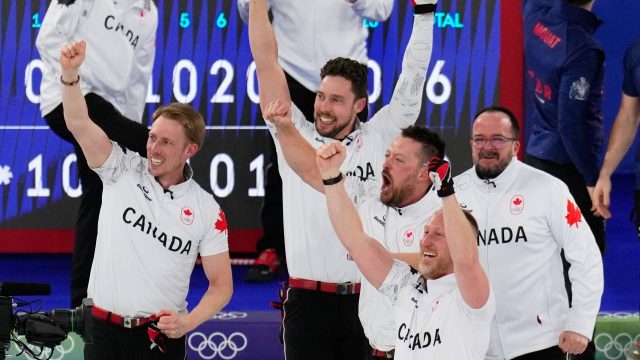
Compared to the previous two Olympics, when the Canadians only won a bronze medal in 2022 for the men’s competition and a gold medal in 2018 for the mixed doubles, this feels huge. But if we’re being honest, this result is what was expected — albeit, probably a reverse of the men’s and women’s results — from Canada heading over to Milano Cortina.
However, the CEO of Curling Canada, Nolan Thiessen, thinks otherwise.
“It’s a successful Olympics,” Thiessen told CBC Olympics. “I mean, playing in two medal games is huge.”
“We’ve got great players that go out there and battle because the world is really hard, but we’re still the best nation in the world at curling.”
Canadian curling used to stand on the same pedestal as hockey in the sense that the country was expected to dominate the entire event, and nothing less than a gold-medal game would do. That’s not the case anymore. Even though Canada is still unquestionably the deepest and hardest country to advance from, the world has not only caught up, but some have passed Canada.
Look at Sweden, which won two of the three gold medals at these Games.
Obviously, this was an improved showing for Canada with two medals, one of them gold, but there is still room to grow back into the powerhouse curling country.
Why Olympics needs to change playoff format to Scotties/Brier
You can understand that all the teams need to be at their best throughout the entire event. However, seeing Switzerland’s men go undefeated and Great Britain’s mixed doubles team go 8-1 through round-robin play only to have a one-off game or even end in the semifinal ruin their chance of gold doesn’t sit right.
Only the top four teams advancing to the playoffs works well, but the actual playoff format should be changed.
Instead of playing a 1 vs. 4 and 2 vs. 3 semifinal, it should be a 1-2 Page playoff game where the winner advances straight to the final, while the loser drops to the semifinal.
Followed up with a 3-4 Page playoff game where the winner plays in the semifinal, while the loser finishes fourth overall. Whoever wins the semifinal goes to the gold-medal match, and the loser takes home bronze. This format is proven to work; it is exactly how the Scotties and Brier are set up.
This way, you truly get the two best teams over the course of the week battling for gold.
Now that the Olympic cycle is officially over, the landscape of curling will change significantly. Many teams came together after the 2022 Olympics for this quadrennial, and due to performance or age, you can expect many roster announcements in the coming months as teams build towards competing at the 2030 Winter Olympics in the French Alps.